Pages

Aug 24, 2015

Reading, Writing, and Arugula

9th Grade environmental science students taking notes, trying the radishes, and learning about Real Foods Farms in May 2015.

We were studying the nitrogen cycle and agriculture at the time. On the farm we focused on their nitrogen management practices ( composting, legume cover crops, and a bioswale ) and then planted the Native American trio of the 3 Sisters ( corn, beans and squash) which is both nutritionally and ecologically sustainable. ( FS donated the seeds and seedlings )


What Blooms: Beardtongue and Bluestar

Another early summer post:


Kay says:
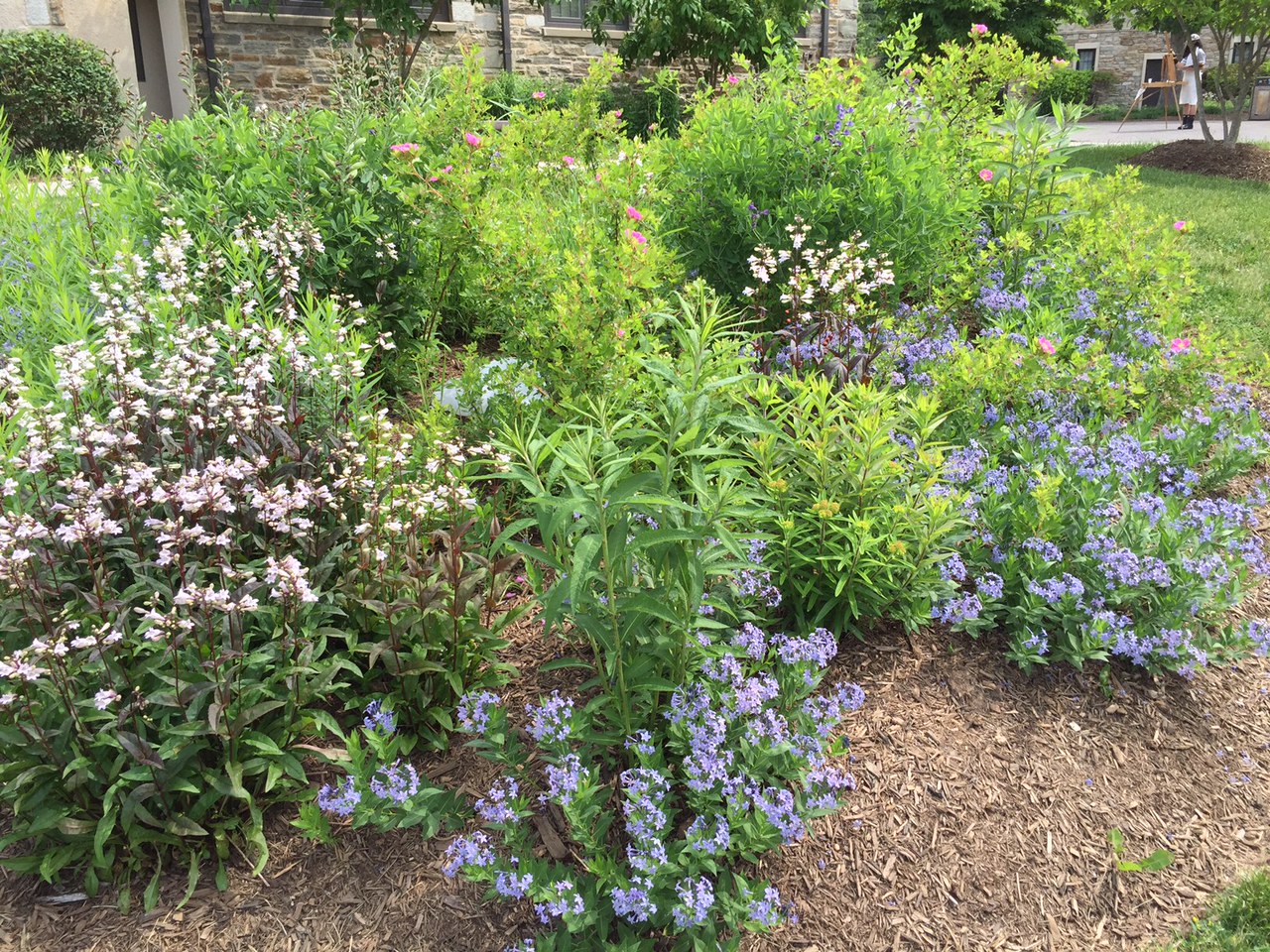
This white and blue combination is Penstemon digitalis 'Husker Red'--Beardtongue--and Amsonia tabernaemontana 'Blue Ice'--Bluestar--, a cultivar of Amsonia tabernaemontana that has been selected for its dwarf size and peacock blue flowers as well as its brilliant yellow and maroon fall foliage.  
Amsonias are a very useful, carefree garden plant that tolerate many conditions--wet, dry, sun, shade.  They have various leaf shapes and heights, and are a wonderful plant for massing and texture.
You can find these in gym beds, beautiful anytime of year, blooming in early June. 

Ask Kay What's Blooming? #5 Sweetspire and Beardtongue

The summer got away, so these posts aren't about what's blooming now--these are from early June.


Kay says:
Virginia Sweetspire--in this case Itea virginica 'Merlot'--is a wonderful four season shrub that is an important design element in the Staircase Garden.  It forms colonies and prefers moist conditions, so we have placed it on the uphill side of the sitting walls and near boulders where water will collect.  This generous plant offers dense red twigging in winter, lustrous green leaves that turn brilliant red in fall, and fragrant creamy white flower racemes--"spires"--in spring is a wonderful nectar plant for butterflies and a great plant for massing and stabilizing banks in the garden.

The second plant in this white and white color pairing is Penstemon digitalis 'Husker Red'--Beardtongue--a signature plant throughout the Native Plant Teaching Gardens.  Its burgundy basal leaves are semi-evergreen, and in late May, clouds of white flower spikes can be seen in many gardens.  Allowing these spikes to form seedheads and drop seed has created great drifts of plants that form a sturdy groundcover. 
By covering as much soil as possible with plants, there is less space available for weeds so that less mulch is necessary in the beds, conserving labor, money, and all of the fossil fuels necessary to transport mulch. It also reduces the opportunity for weed seeds that may travel within the mulch to be brought into the gardens. 


Ask Kay: What's Blooming #4 Columbine


...in which we ask Kay, what's this?


The harlequin red/orange and yellow flowers are Aquilegia canadensis--Columbine.  They are a great hummingbird and butterfly attractor and have large reservoirs of nectar.  They are also the only food source for the larvae for the Columbine Duskywing butterfly, Erynnis lucilius, a little green caterpillar that will eat the lovely fine-textured blue green leaves but not the flowers; Columbine leaf miners will also eat the foliage, and you can sometimes see their tracks across the leaves.  Columbine will set seed and spread itself around in gardens in a charming, unpredictable way.  The plants go semi-dormant in the summer.


Columbine grows in woodland ledges and rocky outcrops in nature and enjoys moisture in the spring and dry conditions in the summer.  It is not easy to transplant, but can be planted from the dried seed capsule in mid-summer.  I let it grow wherever it wants to be!

Editor's notes:
That's Penstemon digitalis blooming behind it. You can find both of these flowers around campus but especially on the US step beds and in the MS beds. I posted this in August, but they bloom in late May and June. 

May 19, 2015

Ask Kay #3 Chrysogonum virginianum

In Ask Kay #3, we learn about:
chrysogonum virginianum

Chrysogonum virginianum (Green and Gold or Goldstar) is a compact, lush groundcover that grows in partly sunny to shady sites.  It has clean, green foliage and abundant bright golden yellow flowers.  Chrysoganum blooms heavily in mid spring and sporadically throughout the rest of the growing season.  Look for it in the Staircase Garden around the boulders at the top.

More details here at Missouri Botanical Garden page about this flower. This is a great resource for anyone interested in North American plants.

Ask Kay What's Blooming #2: Fringe Tree

Hi Kay,

what do we have here? 
Fringe Tree and Wild Geranium

Kay Says: 
On the north side of the Middle School, on the south side of the Dining Hall/Gym, and in the Picnic Glade, and by Admissions, Chionanthus virginicus, (common names: Fringe Tree, Grancy Greybeard, Old Man's Beard) is blooming.  "Chionanthus" comes from combining  the Greek words "chion" and "anthus" to make "snowflower".
 A spine of Geranium maculatum (Wild Geranium) runs up the slope beneath the Fringe trees next to the Middle School--the geranium is a shade loving plant that will be happy in the shelter of the taller perennials and shrubs that will fill out and bloom later in the summer and fall.  If you look closely, you will also see some tiny iris--Iris cristata--intermingled with the Geranium.
 Look for the peacock blue of  Amsonia tabernaemontana 'Blue Ice' (Blue-star) under the trees against the wall of the Dining Hall/Gym, another fun color combination for this tree.

 Thanks Kay! So: next time you find yourself serenading someone with Oklahoma lyrics, try this variant: "When I take you out in a surrey with the fringe Chionanthus virginicus on top." Pro tip: If you're serenading, probably best not to call anyone on your Oklahoma-themed date "Grancy Greybeard."


Apr 25, 2015

Ask Kay What's Blooming #1: Poppywort Report

Here at Friends we are doubly lucky: we have lovely Native Plants Teaching Gardens, and we have master gardener, designer, educator Kay McConnell, who is responsible for much of their design, plantings and yearly maintenance. See this post for more on the Native Plants Teaching Gardens. But here's our news today: Kay has offered to identify and describe what's blooming now. Here's how it works: I send her a photo of something pretty on campus, and she tells us what it is. So, time for a poppywort report:

Dear Kay, What's this?


Kay says: 
This cheerful wildflower is Stylophorum diphyllum.  The common names are Wood Poppy, Celandine Poppy, and Poppywort.  It loves to grow in moist woodlands and freely seeds where it is happy.  It is planted in front of the Lower School by the bridge. 

Thanks Kay! 

Apr 24, 2015

MS Earth Day: Sweat, Sunblock and Seedlings at the Boone Street Farm

Scott Harrington, Middle School Principal, writes in to tell us about the group of MS students busy at Boone Street Farm last Friday:

It was quite a surprise to be worrying about sunburns while gardening on April 17, the Friends School version of Earth Day.  It was supposed to be cold and rainy.  But a group of 12 Friends Middle School students spent the day weeding, preparing beds, mulching, and planting seedlings at Boone Street Farm an urban garden that's part of the Farm Alliance of Baltimore City, and many of us turned a shade of red from the hot sun. 


We not only helped four of the Boone Street Farm staff prepare the beds for the summer crop, but also gave the place a bit of a shine for their own Earth Day celebration on April 22.  One special treat of the day was our partnering, unexpectedly, with some neighborhood children who have taken interest in the farm, and decided to help out and join us for lunch.  If you are interested in supporting Boone Street Farm, you can purchase their produce at the Waverly Farmers Market (under the Farm Alliance of Baltimore's tent), or you can contact them to join their CSA (Community Supported Agriculture).  

Apr 20, 2015

Proper Puddles Prevent Pollution

Now that's a good-looking puddle. Actually, that's the new rain garden significantly reducing parking-lot runoff by the new Little Friends building. As a Quaker school, stewardship of the local environment is a core value, and this puddle is doing its part. After a recent heavy rain, all of this water ends up here instead of flowing directly into the storm drains. Too much rainwater (especially when it comes off of hot asphalt and is contaminated by engine oil and other pollutants that accumulate on impervious parking lot surfaces) can cause severe damage to local waterways. That puddle will drain over the next day or so, and the plants in this swale will filter and dilute the pollutants, keeping them out of Stony Run.

Rain Garden by Little Friends

Time to Cheer for Amelanchier (Native Trees Aflower on Campus Now!)

It must be spring: we've got redbud and serviceberry trees blooming all over the place!

Cercis Canadensis (Redbud) by Admissions:


Serviceberry (also known as Shadbush and Juneberry) produces a delicious edible berry in, yupp, June. These are an important food source for native birds too, but sneak a few yourself if you can (and only if you're sure you know it's not something else--remember lots of berries only look edible.)

Amelanchier Canadensis (Serviceberry) by Lower school and adjacent to the community garden:

Meanwhile, in 9th grade English, we're about to start Shipwrecks, a book about medieval Japan in which seasonal change and "mono no aware" (the bittersweetness of ephemeral beauty and bounty) are key concepts. See 'em while you can!